- Technical Application Background
In petroleum production, the wellbore lifting of high-wax and high-pour-point crude oil has long been a core problem restricting efficient oilfield production. Once the wellbore crude oil temperature drops below the wax precipitation point or pour point, wax components in crude oil crystallize and deposit continuously, leading to a sharp deterioration in crude oil fluidity and a rapid increase in viscosity. This easily causes failures such as pump sticking, tubing wax blockage and increased lifting resistance. These issues not only reduce oil well production efficiency and increase operation failure rates, but also shorten the service life of downhole tubulars and production equipment, greatly raising the overall operation and maintenance costs of oilfields.
Traditional mainstream processes in the industry, including steam hot washing and chemical paraffin removal, have obvious technical shortcomings and limitations. Steam hot washing is characterized by high energy consumption, frequent operations and short effective periods, resulting in high long-term comprehensive operating costs. Chemical paraffin removal may cause formation pollution, increase the difficulty of produced liquid treatment, pose potential environmental risks, and deliver poor sustainability of paraffin control effects. Against this background, the hollow rod electric heating technology, with the technical advantages of high efficiency, controllability, environmental friendliness and long-term effectiveness, has become a core process to solve the bottlenecks in the development of high-pour-point and high-wax crude oil.
- Core Technical Principle: Skin Effect Electric-Thermal Conversion and Accurate Heat Transfer
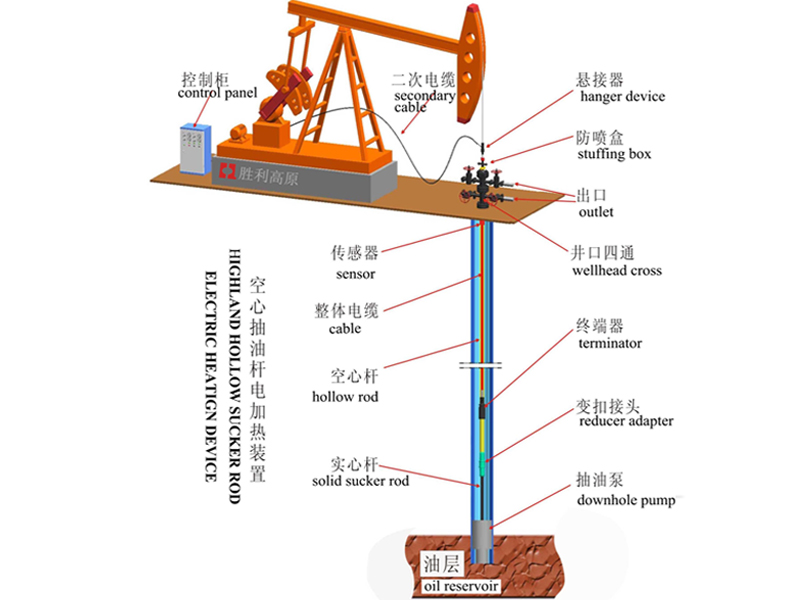
The core principle of the hollow rod electric heating technology is the AC skin effect, which realizes continuous constant-temperature paraffin prevention for wellbore crude oil through downhole in-situ electric-thermal conversion and precise heat conduction. This technology adopts special hollow sucker rods as the core heat carrier, with high-temperature and high-pressure insulated cables pre-installed inside the hollow rod cavity to form a complete conductive circuit.
When power-frequency alternating current forms a closed loop through the cable core, hollow sucker rod and stratum, the AC skin effect concentrates current on the ultra-thin inner wall surface of the hollow rod. Electric energy is efficiently converted into thermal energy relying on the metal resistance, enabling uniform and stable temperature rise of the entire hollow sucker rod. The generated heat is directly transferred to the crude oil in the tubing through the rod wall, achieving continuous and controllable in-situ heating of crude oil in the target well section. The crude oil temperature is always maintained above the wax precipitation point, fundamentally inhibiting the precipitation, aggregation and deposition of wax crystals, ensuring excellent fluidity of crude oil and meeting the requirements of normal lifting production.
- Key System Composition and Cooperative Operation Mechanism
The complete hollow rod electric heating system consists of five core components operating in precise coordination to form a closed-loop controllable downhole heating system. Each component has clear functions and strong adaptability, ensuring the safe, stable and long-term operation of the system:
- High-strength Hollow Sucker Rod
Fabricated from high-quality high-strength carbon steel, it integrates the dual functions of mechanical oil production lifting and conductive heating, serving as the core heat carrier and stress-bearing component of the system. Featuring high structural strength, deformation resistance and adaptability to complex downhole working conditions, it supports long-term reciprocating downhole operations while ensuring uniform and stable conductive heating performance.
- Built-in Special High-temperature Resistant Cable
A custom downhole power transmission cable equipped with high-temperature resistant, high-pressure resistant and corrosion-resistant insulating protective layers. It adapts to the complex downhole environment of high temperature, high pressure and high salinity, stably transmits current for a long time, provides continuous and safe power input for the downhole heating circuit, and eliminates potential safety hazards such as electric leakage and insulation breakdown.
- Ground Intelligent Control Cabinet
As the core control center of the entire system, it undertakes the functions of power voltage stabilization, parameter monitoring and intelligent regulation. It can real-timely collect, display and closed-loop adjust key parameters such as system output current, voltage, heating power and downhole crude oil temperature, accurately match the heating requirements of different well conditions, ensure safe, energy-saving and efficient heating processes, and realize fully automatic unattended operation.
- Special Wellhead Matching Device
Integrated with special insulating hangers and high-pressure sealing components. On the one hand, it realizes safe insulated connection between downhole cables and ground power supplies to ensure the safe introduction of high-voltage power underground. On the other hand, it achieves dynamic wellhead sealing, effectively preventing leakage of wellbore medium and pressure, and adapting to high-pressure oilfield production conditions.
- Downhole Intelligent Sensing Module
Deployed at key downhole monitoring points, it real-timely collects core data such as wellbore temperature and operating conditions, and feeds data back to the ground control cabinet. It provides accurate data support for system power regulation, temperature control and fault early warning, realizing full-process intelligent and precise regulation.

- Core Technical Advantages and Application Value
Compared with traditional processes such as steam hot washing and chemical paraffin removal, the hollow rod electric heating technology has multiple core advantages including excellent paraffin control effect, significant production increase, high intelligence and economic and environmental benefits, with prominent application value:
- Excellent Paraffin Control Effect and Greatly Reduced Operation and Maintenance Costs
Adopting the wellbore in-situ continuous heating mode, the technology increases the overall crude oil temperature from the source, thoroughly inhibits wax crystal precipitation and pipe wall deposition, greatly extends the hot washing cycle, and can completely replace traditional hot washing and chemical paraffin removal operations under most well conditions. It significantly reduces the frequency of downhole operations and cuts down comprehensive costs including equipment maintenance, chemical agents and manual operation expenses.
- Optimized Crude Oil Fluidity and Remarkable Production Improvement Effect
Constant temperature heating effectively reduces crude oil viscosity, improves wellbore fluid fluidity, greatly decreases the lifting load of the oil pump, enhances pump filling degree and oil production system operation efficiency, reduces equipment wear and pump-stopping failures caused by pump sticking, and effectively improves the stable production and capacity enhancement capacity of single wells.
- Intelligent Closed-loop Control with Safe and Stable Operation
A closed-loop regulation system is formed by the ground intelligent control cabinet and downhole sensing module, which can dynamically adjust heating parameters according to well conditions with high automation and strong adaptability. The system operates stably with low failure rate, requires no frequent manual intervention, and greatly simplifies on-site management procedures.
- Energy-saving, Low-carbon and Environment-friendly with Outstanding Long-term Economic Benefits
Adopting a full physical electric heating mode, no chemical paraffin removal agents are required, completely eliminating chemical pollution risks. Meanwhile, it avoids the problems of high energy consumption, high emission and cumbersome waste liquid treatment of traditional steam hot washing. Featuring energy conservation and environmental friendliness, its long-term production investment cost is far lower than traditional processes, with obvious comprehensive economic advantages.
- Field Application and Effect Verification
This technology is widely applicable to high-pour-point oil wells, high-wax oil wells and conventional heavy oil wellbore lifting conditions with strong adaptability. Large-scale application practices in a high-wax and high-pour-point block of an oilfield in Northeast China show that after the adoption of the hollow rod electric heating technology, the average hot washing cycle of target oil wells is extended from 30 days to more than 180 days. The wellbore wax deposition problem is completely solved, the water cut of oil wells decreases by 15% on average, the daily oil production of single wells increases steadily, the frequency of downhole failures is greatly reduced, and equipment operation and maintenance costs are significantly cut down. The results fully verify the high efficiency and reliability of this technology under complex working conditions.
- Summary and Application Prospect
Relying on the precise electric-thermal conversion principle of the skin effect, the hollow rod electric heating technology realizes controllable, continuous and efficient heating of wellbore crude oil, fundamentally breaking the fluidity bottleneck in the development of high-wax and high-pour-point crude oil. With the comprehensive advantages of high efficiency and energy saving, intelligent controllability, safety and environmental protection, and long-term stable production, it not only effectively improves the production efficiency and development benefits of complex oil wells, but also provides a strong technical support for the green and sustainable development of high-pour-point and high-wax oil reservoirs.
With the continuous iteration and upgrading of new high-temperature resistant materials and intelligent precise control technology, the stability, energy efficiency and intelligence level of the hollow rod electric heating technology will be further improved. In the future, it will play a more critical role in intelligent oilfield construction and efficient development of complex hard-to-produce oil reservoirs, with broad promotion and application prospects.